



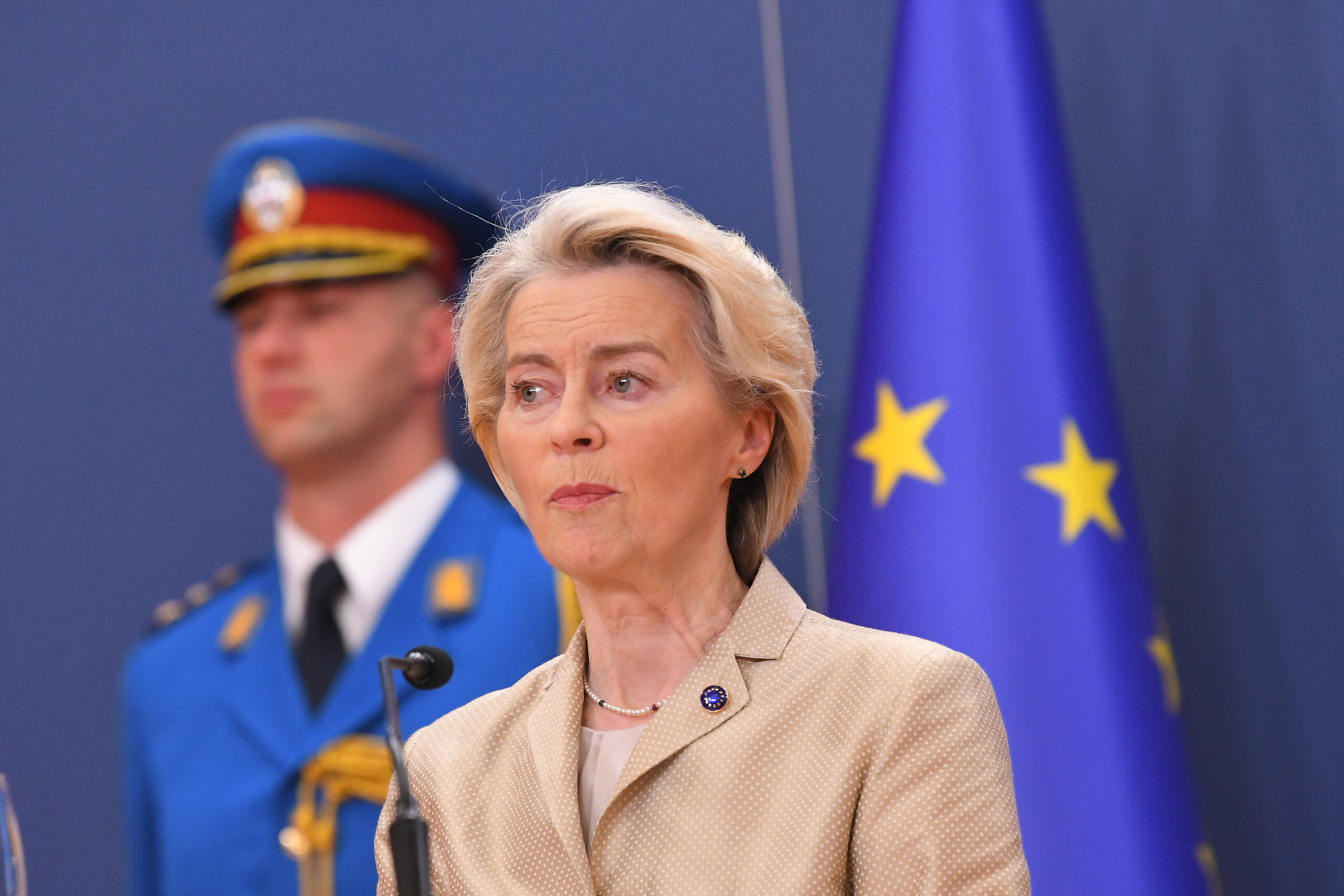
The President of the European Commission, Ursula von der Leyen, will visit Skopje on Friday, October 2, as part of her tour of Western Balkan countries.
Von der Leyen is scheduled to meet with the President and Prime Minister of North Macedonia, Gordana Siljanovska Davkova and Hristijan Mickoski, with whom she will discuss the European perspective of their country and the region. It is also expected that the issue with Bulgaria and possibilities for overcoming it will be addressed.
“With the President of the European Commission, Ursula von der Leyen, who is coming to Skopje on Friday as part of her tour of Western Balkan countries, we will discuss the current situation regarding the enlargement process and the challenges that have arisen and those that lie ahead,” Mickoski told reporters.
Asked whether the issue of EU participation in negotiations with Bulgaria would be raised with von der Leyen, Mickoski replied that he believes it is good to have representatives of the European Commission and the EU in the talks so that arguments can be heard objectively, and that his government is ready and willing to discuss everywhere and on every topic.
“It is logical to sit and talk in the presence of EU representatives because arguments need to be heard objectively. Otherwise, when we sit and talk on a bilateral basis, what is discussed lacks substance,” Mickoski said.
North Macedonia’s EU accession negotiations have been blocked due to a bilateral issue with Bulgaria, which has become part of the Negotiating Framework.
Skopje began the “first phase” of negotiations with the EU in July 2022 by adopting the Negotiating Framework, but to move to the “second phase” and start opening chapters, it must include Bulgarians in the Constitution, which Prime Minister Hristijan Mickoski’s government does not want to do without guarantees that this is the last bilateral demand in the accession negotiations.
The European Commission President’s tour of the Western Balkans will begin on September 30 in Albania, after which she will visit Kosovo and Montenegro.
Serbia and Bosnia and Herzegovina will not be on her agenda this time because, as stated by European Commission spokesperson Arianna Podesta, those countries are preparing for elections.
Serbia will hold early parliamentary elections on October 25, while Bosnia and Herzegovina will hold elections on October 4.

Your perspective is part of the story
Read other perspectives and join the conversation.