



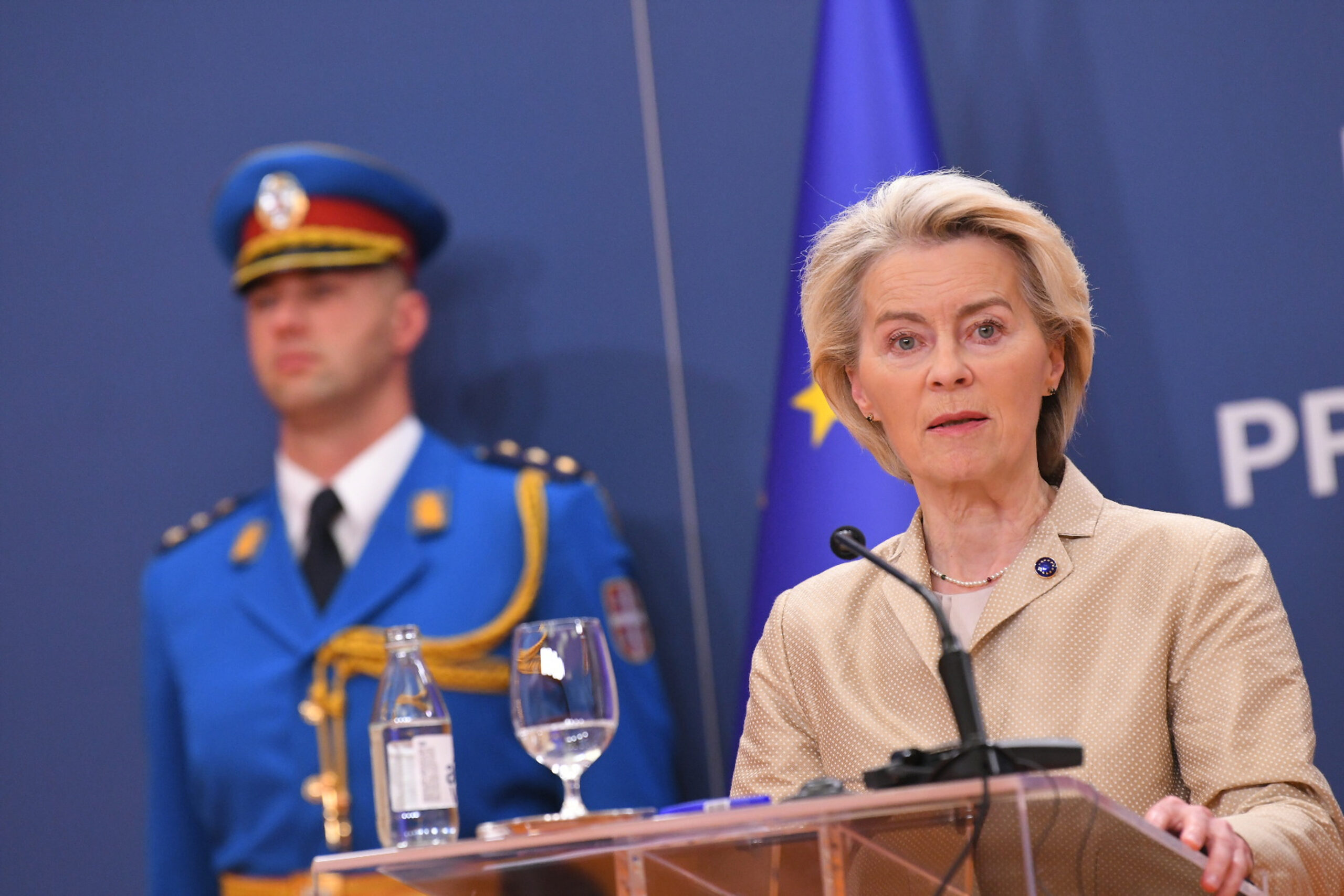
The President of the European Commission, Ursula von der Leyen, will deliver a State of the European Union address tomorrow, in which she will present priorities for the coming year and a vision for addressing the challenges facing the world’s largest trading bloc.
The content of Ursula von der Leyen’s address to the European Parliament in Strasbourg is being kept secret. Political groups within the parliament have lobbied to have their priorities and projects, which are of particular importance to them, included in the speech.
Nevertheless, the speech is expected to touch on topics such as artificial intelligence, climate change and the fires that affected Europe this summer, as well as child protection online, Russia’s war against Ukraine, conflicts in the Middle East, and tensions in international trade.
Last year, the President of the European Commission warned that Europe must secure its independence, while the Trump administration was imposing additional tariffs and criticizing the EU’s migration policy.
“Europe is fighting. Fighting for our values and our democracies,” Ursula von der Leyen said last year.
Tomorrow’s speech has become an annual ritual modeled after the State of the Union addresses that U.S. presidents deliver before Congress, but it will not be widely broadcast, so it is unlikely to be followed by the large number of 450 million EU citizens from 27 member states.
It is a carefully crafted communication move before parliamentarians who often applaud, and is most appreciated by those familiar with the workings of the EU.
Ursula von der Leyen usually ends her speech with a message that has become her slogan – “Long live Europe”.
The topics are typically ambitious. They concern the hopes and plans of Ursula von der Leyen for the Commission in the coming year, but often lack details. Critics claim that the Commission’s work is non-transparent.
Eric Maurice, an analyst at the European Policy Centre think tank, warned that Ursula von der Leyen should not use the speech “to please political groups” or “to boost her own ratings and expand the political and institutional reach of the Commission”.
“The EU is facing the collapse of all the foundations on which it was built. The rules-based order, with benevolent free trade and the friendship and support of the USA, is disappearing,” Maurice said.
The Commission proposes laws that apply in all 27 member states and oversees compliance with existing regulations. It negotiates trade on behalf of all members and serves as the main European body for market competition oversight.
It is headed by the sixty-seven-year-old former German defense minister, who has become a prominent figure at summits with world leaders, despite having been appointed to this high European position by political decision rather than direct election.
Ursula von der Leyen is hard to ignore. During her seven years in office, she has gained significant influence by securing vaccines during the coronavirus pandemic, managing the energy crisis caused by the Russian invasion, and providing support to Ukraine during the war.
She also appears to enjoy a certain, albeit reluctant, respect from U.S. President Donald Trump.
She, her chief of staff, and the trade commissioners have made great efforts to mitigate the damage inflicted on the European economy by Trump’s “tariff war”.
Nevertheless, the Trump administration is dissatisfied with the Commission’s tough measures against major technology companies, many of which are from the U.S., for failing to comply with European data protection regulations.
Ahead of the speech, the Commission launched a website dedicated to its president and the event itself, and distributed brochures presenting the results achieved over the past 12 months.
The list of these achievements includes the conclusion of new trade agreements, strengthening economic competitiveness, reducing energy costs, encouraging investment in defense, providing several billion euros in aid to Ukraine, as well as imposing sanctions on hundreds of Russian officials and organizations.

Your perspective is part of the story
Read other perspectives and join the conversation.