



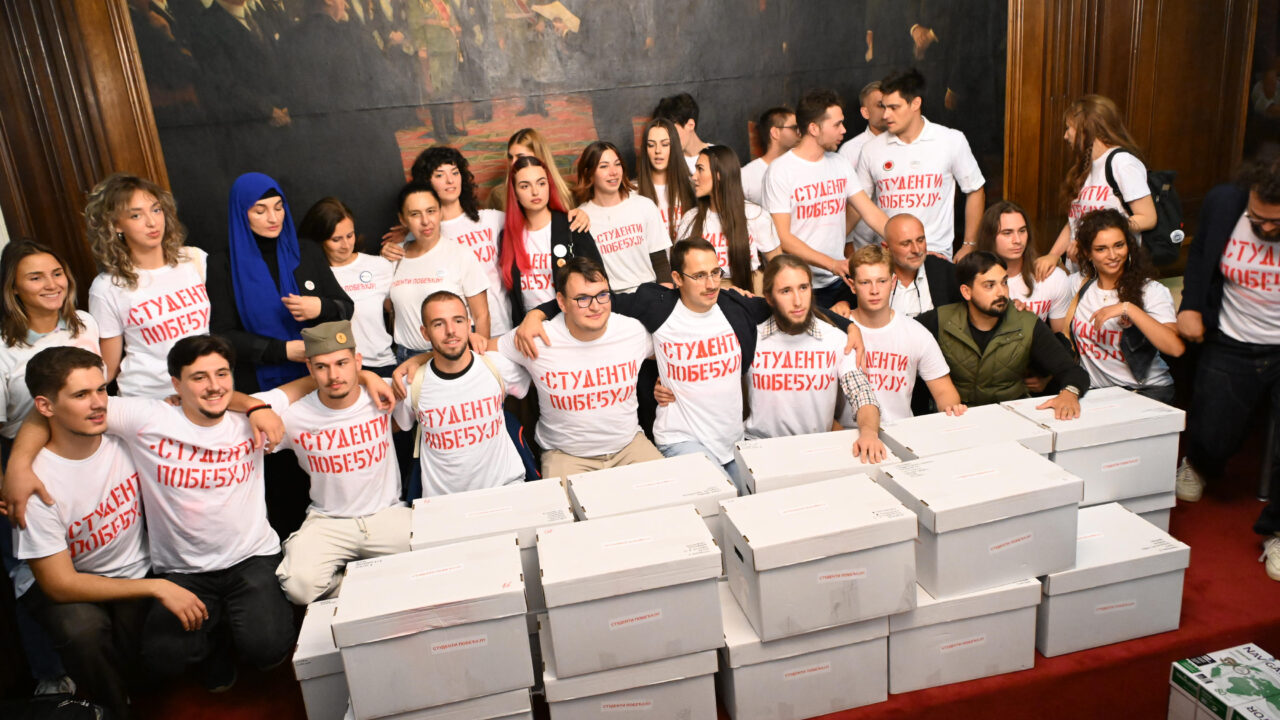
The student protest movement has been shaking Serbia for two years, and this weekend it will attempt to take power, writes the British Guardian today, adding that an unorthodox campaign is challenging the 12-year rule of the ruling party in a bold democratic experiment.
According to the paper, students hope that Vučić will suffer a defeat similar to that of Viktor Orban in neighboring Hungary six months ago, triggering a domino effect that could lead to a democratic revival in Central Europe.
Public opinion poll results vary greatly, but many expert observers believe that an uncertain electoral race is entirely possible, in which neither side is prepared to accept defeat as a legitimate outcome. This increases the risk of unrest and conflict after the elections, the Guardian points out.
The paper emphasizes that for the Student List, with its 250 candidates, to win, it would have to change the established patterns of Serbian politics and break Vučić’s control over the country.
The author describes that the volunteers he accompanied while visiting one of Belgrade’s neighborhoods encountered exceptionally strong support.
Apart from a few polite refusals at the doorstep, with the explanation that they are not interested in politics, people were eager to express their dissatisfaction. Most promised to vote for them, and many offered help. Some taxi drivers said they would help transport voters to polling stations, the paper writes.
The Guardian notes that citizens most frequently cited corruption as the biggest problem in society and adds that on the Transparency International corruption index, Serbia is ranked significantly worse than all its neighbors and, excluding the dictatorships in Belarus and Russia, is the most corrupt country in Europe.
There are also frequent allegations of links between SNS and organized crime, and the Student List’s slogan directly confronts this widespread perception by posing the question “Serbia or the mafia?” while the authorities reject all accusations and officially claim to be fighting organized crime, the paper writes.
There are numerous shortcomings in infrastructure as well, adds the Guardian, recalling that the student protests were sparked by the collapse of a concrete canopy at the railway station in Novi Sad on November 1, 2024, when 16 people were killed, and that despite evidence pointing to poorly executed reconstruction work, the official cause of the accident has not yet been determined, nor has any official been held accountable.
The paper writes that students initially distanced themselves from opposition parties and avoided any form of hierarchy or usual leadership structure. This was partly an ideological choice and partly a practical decision. SNS and state media maintain their power in part by discrediting opponents, while the students’ collective approach provided fewer individual targets for attacks.
The Guardian reports the results of a survey published in July by the Center for Research, Transparency and Accountability (CRTA) and Stanford University, according to which students enjoy significantly greater support (45 percent) than SNS (36 percent). However, the survey was conducted long before Vučić announced his resignation on September 27 and his election machinery began operating at full speed. Other, more recent surveys by domestic agencies show that SNS is in the lead, although the opposition believes that the agencies conducting them are sympathetic to the authorities, the paper adds.
The Guardian assesses that Vučić himself shows that he takes the political threat seriously enough to personally join the campaign.
In August, he had 129 live television appearances, more than four times as many as the previous month. After failing to break the student movement by force, by causing divisions, or by discrediting it, Vučić opted for a risky move. He announced his resignation as president and called snap elections, apparently hoping to catch the students unprepared. They, however, responded by improvising a democratic experiment.
The Guardian notes that candidates for the 250 seats were mostly nominated by faculties and that among them are more than 160 PhDs, as well as a smaller number of farmers and representatives of other professions. Each candidate had to be approved at plenary sessions of the student movement.
The list’s program was also determined at plenums, which is why contentious issues, especially foreign policy, were pushed into the background. The decision on future EU membership was left to a referendum, while Kosovo is still considered an integral part of Serbia, the paper writes.
Stating that the Student List is facing the political monolith of SNS, which has been in power for 14 years and controls the state apparatus, the Guardian adds that students tried to bypass the authorities’ dominance over the media with a “door-to-door” campaign and by sending activists “to every village.”
The outcome of the elections could depend on whether these student envoys succeed in changing the attitudes of rural voters, the Guardian assesses.
The paper also writes that in the case of an uncertain electoral race, other factors are expected to play a role and that parties of national minorities representing ethnic Hungarians, Bosniaks, and Albanians could become key to forming a government.
The Guardian also notes that the Student List plans to engage an unprecedented number of opposition observers on Sunday to prevent electoral manipulations such as vote buying, voter intimidation, and the insertion of additional ballots into ballot boxes. However, on the other hand, this could increase the risk of conflict on election day.
The Guardian also reports estimates from diplomatic circles that Vučić’s plans to organize a major international event, EXPO 2027, next year could limit violence.
If his hold on power is threatened, Vučić also has the option to demand repeated vote counts, hoping that the momentum of the student movement will fade over time, but, the Guardian points out, the student movement is determined not to allow this and in recent weeks has focused its preparations on a strategy of street action after the elections to defend a possible victory.

Your perspective is part of the story
Start the discussion and be the first to comment on this story.