


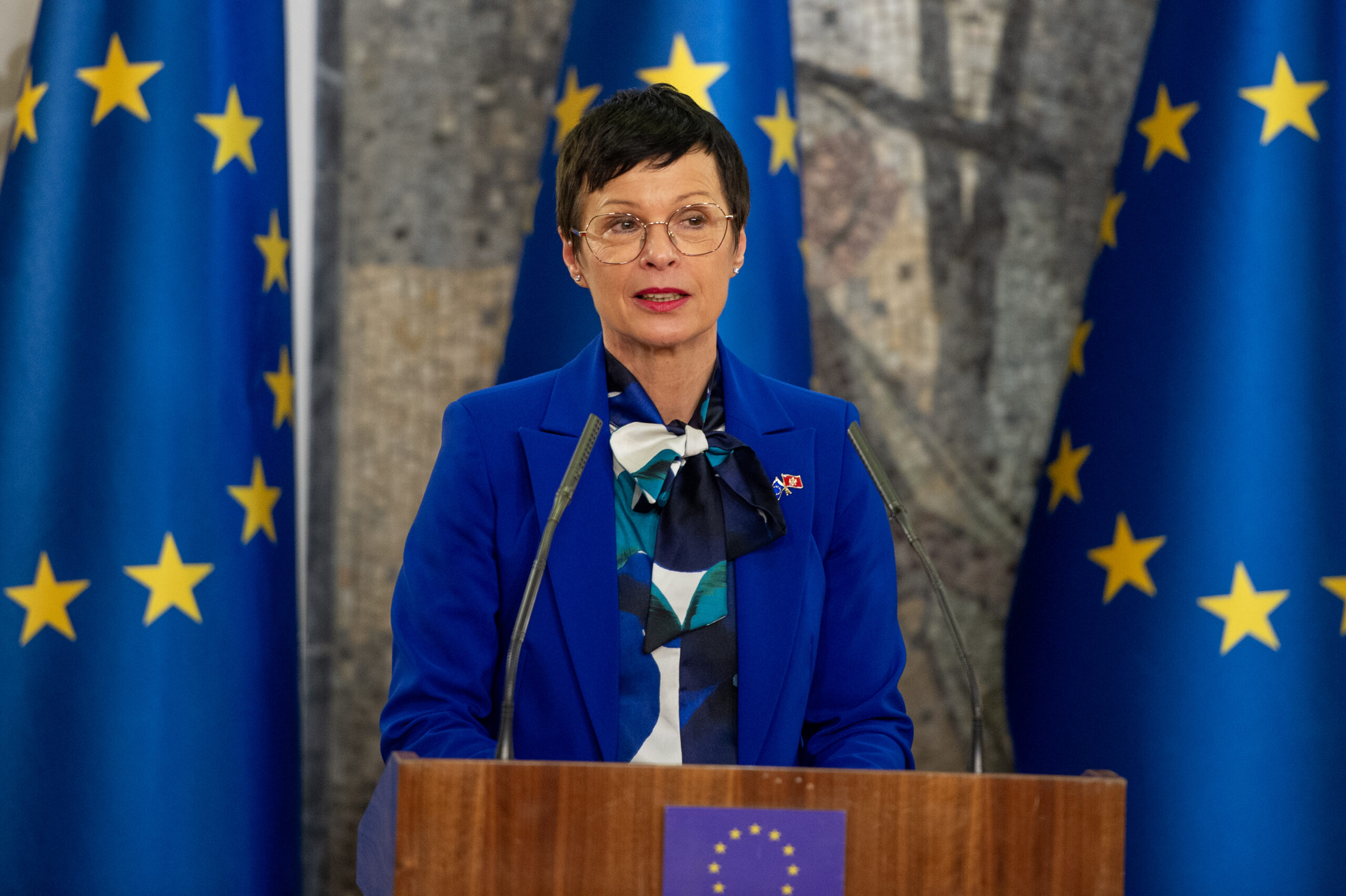
European Commissioner for Enlargement Marta Kos stated today that the signing of Montenegro’s accession agreement with the EU by summer 2027 is realistic, provided that Montenegro fully implements reforms and resolves outstanding issues with Croatia in the spirit of good neighborly relations.
In an interview with Radio Montenegro, Kos said that Brussels supports the goal for Montenegro to become the 28th member of the European Union in 2028.
Kos emphasized that Croatia’s demands towards Montenegro are not a formal part of the negotiation process with the EU, but that outstanding issues with Zagreb must be resolved because the consent of all 27 member states is required for further progress towards membership.
Croatia has asked Montenegro to fulfill eight demands before completing accession negotiations, and Podgorica has met two – it changed the name of the municipal swimming pool in Kotor and subsequently approved a commemorative plaque at the former Morinj camp. Zagreb welcomed these decisions as steps in the right direction but stated that it expects the remaining issues to be resolved as well.
Kos said that it is necessary to distinguish the technical part of the accession negotiations, in which the candidate meets EU criteria, from the political support of member states, which is needed for the process to be completed.
“Croatia has its interests and Croatia speaks openly about them,” Kos said, adding that she is encouraged by the steps Montenegro has taken in recent days and by the existence of dialogue between Podgorica and Zagreb.
According to her, Montenegro has done almost everything necessary in the technical part of the process, but for further steps, it must obtain the green light from all Union members.
“These bilateral issues are not part of the negotiation process, but (…) they must be resolved,” Kos said.
This week, the Montenegrin government decided that the swimming pool in Kotor, which since 2021 had borne the name of former water polo player Zoran “Džimi” Gopčević, will henceforth be called “City Pool – Petar II Petrović Njegoš”.
Zagreb opposed the previous name, claiming that Gopčević was a guard at Morinj, where Croatian civilians and prisoners of war were detained during the war in the early 1990s. The name change of the pool was one of the eight demands Croatia made to Montenegro.
At the same time, the government subsequently approved the commemorative plaque installed in October 2022 at the entrance to the former military facility Morinj. The decision allows the plaque to remain at its current location, in its present form, and with its existing inscription.
The remaining six Croatian demands relate to compensation for former Morinj detainees, the search for 14 missing Croatian citizens, prosecution of war crimes, property rights of Croatian families in Montenegro, maritime border delimitation, and the issue of the school ship “Jadran”.
Kos assessed that the latest moves show that the two countries are moving towards resolving disputes and that Montenegro, if it continues reforms at the current pace, can achieve the goal of completing negotiations and signing the accession agreement by summer 2027.
She described Montenegro’s progress over the past three years as exceptional, stating that the country has completed almost all the work in the technical part of the process and that only a few steps remain.
Montenegro has opened all 33 negotiation chapters, of which 21 have been provisionally closed. The last three – economic and monetary policy, statistics, and social policy and employment – were closed on October 12.
Kos said that European leaders are now paying much more attention to Montenegro and that it is increasingly clear in Brussels which country could be the next member of the Union. In her opinion, Podgorica’s membership could also serve as an incentive for other Western Balkan countries and show that enlargement is once again delivering concrete results.
Speaking about the decision of the Montenegrin Parliament to, with the support of part of the opposition, adopt the Proposal to amend the Constitution regarding the integrity check of candidates for government members, she assessed that Montenegro has taken another important step towards full membership in the European Union.
“The Parliament of Montenegro has brought your country one step closer to the goal, which is full membership in the European Union. That is truly an excellent result. That result shows that your MPs also know why it is now really important that, if I may use sports language, you are in the final of one of the most important matches Montenegro will play in its history,” said Kos.
She emphasized that the adoption of constitutional changes brings Montenegro closer to closing negotiation chapter 23, and then to completing accession negotiations.
“I understand that it is never the case that everyone is satisfied. But the goal of democracy is for parliament to be the place where differences are discussed and where, in the end, a compromise is reached that most people can live with. That is why what happened on Monday is truly very important for Montenegro’s path to the EU,” Kos stressed.
Asked about the President of the Parliament, Andrija Mandić, whose dismissal did not receive parliamentary support, as well as about opposition criticism over his condolences to the family of convicted war criminal Ratko Mladić, Kos stated that only the Parliament can decide on its leadership.
“Only the Parliament can decide on the leadership, no one else. In the European Union, there is truly no place for glorifying war criminals. It is important, and this has been emphasized by our President Ursula von der Leyen and myself personally, that reconciliation and respect for victims are things that mean a great deal to us in Europe,” said Kos.
She pointed out the responsibility of political leaders to contribute to reconciliation and respect for European values through their actions.
“There is great responsibility on political leaders, especially those in the highest positions, to work in that direction. The history of the former Yugoslavia is full of open wounds. I think it is good that we talk about it, but not looking back, rather looking forward. It is important to say if something is not right, if someone has not done something well. These are our values, and these European values are one of the reasons why Montenegro wants to join the EU,” Kos emphasized.
Speaking about the upcoming Berlin Process summit in Budva, the European Commissioner assessed that Montenegro is at the center of attention of European leaders and that its results are increasingly attracting the interest of member states.
“Montenegro is truly at the center of attention in Europe. I am pleased that the prime ministers and ministers from our 27 member states ask me how things are in Montenegro, how Montenegrins are. When we had the meeting of foreign ministers in Budva at the beginning of the month, everyone said: ‘It is so beautiful, bring Montenegro into the EU.’ I said: It will surely happen. I am joking a little, but it is a great truth,” said Kos.
She believes that the Berlin Process summit, following the Western Balkans summit in Tivat, will further contribute to Montenegro’s international visibility and its European perspective.




Your perspective is part of the story
Start the discussion and be the first to comment on this story.