



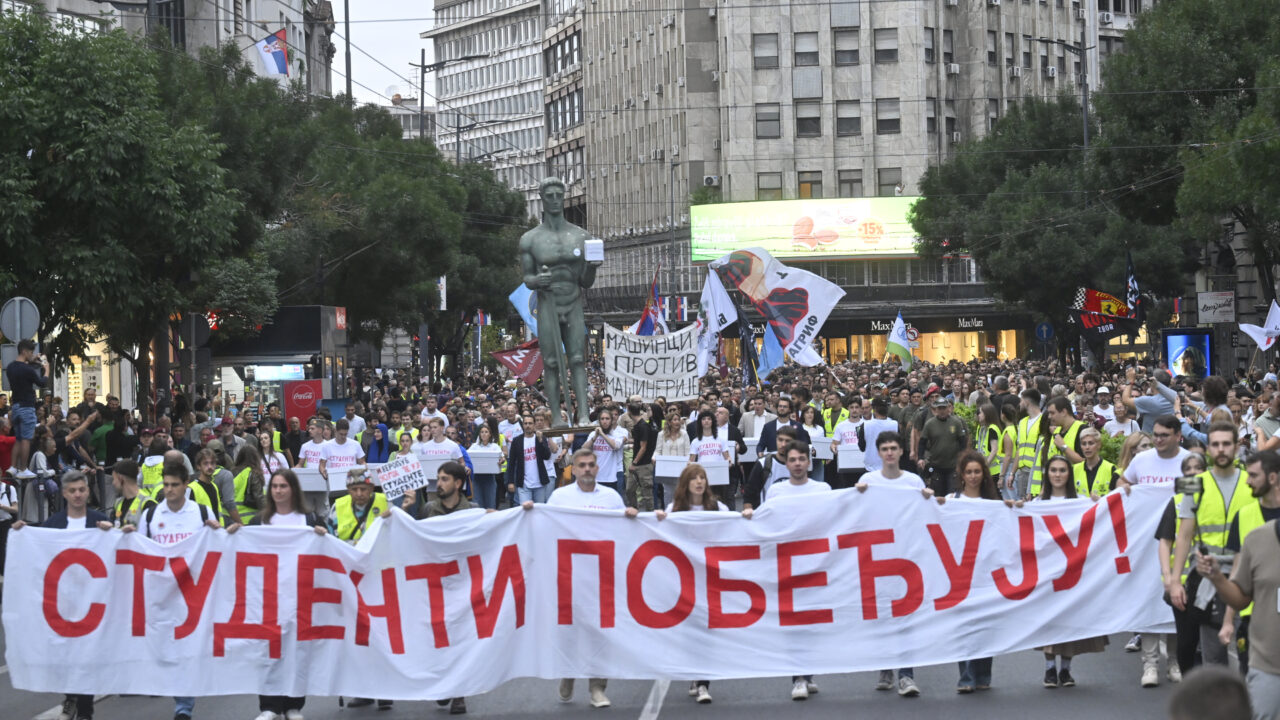
Ahead of the elections in Serbia, there is frequent talk of the Hungarian scenario and whether Serbian students could repeat the success of Peter Magyar against long-time Prime Minister Viktor Orban, but the differences between the two movements are significant, and the question is also whether the current policy in Budapest should serve as a model or a warning to the Serbian opposition, writes the Austrian daily Prese today.
The daily writes that Peter Magyar is not a newcomer to Hungarian politics, and that he held top positions in Orban’s government for a long time before leaving that political family. With a convincing victory in the elections, he not only removed Orban from power, but also the previous, mostly left and liberal opposition, the paper writes.
Unlike him, writes Prese, the Student List in Serbia is not a splinter group from the ruling camp, but rather young people who are just entering politics. They avoid creating clear hierarchical structures, organize themselves at universities, resolve issues based on the principles of grassroots democracy, even if it means endless debates.
“In Hungary, everything is precisely and hierarchically orchestrated. Magyar is the leader, followed by his party as the vanguard—people have no right to vote. They could support the campaign, but not decide on party lines. Magyar’s party to this day does not accept new members, it consists of only 28 ‘chosen’ individuals and acts as a closed elite unit. The Hungarian ruling party lacks not only grassroots democracy, but any kind of intra-party democracy,” writes Prese.
The paper notes that there are similarities in tactics and rhetoric between the two movements, that both do not see themselves as either left or right. “This allowed Magyar to present the April elections as a referendum on Orban, while political and ideological issues were largely pushed aside.”
“Just as Magyar was to Orban, the students (in Serbia) do not represent a clear ideological alternative to the existing system in Serbia—they criticize political practice, but not political orientation,” assesses Prese in a text by Peter Tehet, a lawyer and historian from the Institute for the Danube Region and Central Europe in Vienna.
According to the daily, Serbia and Hungary also share the fact that both societies are relatively “conservative and nationalist,” something that even opposition movements cannot and do not want to rid themselves of.
On many contentious issues, such as Ukraine, migration policy, and minority rights, Magyar remained silent or simply adopted Orban’s positions, knowing that the left and liberal electorate, lacking an alternative, would vote for him, but he also needed a conservative majority. That is why he used strong nationalist rhetoric and symbolism, writes Prese.
“In Serbia, this is even more pronounced since anti-European, pro-Russian, and nationalist positions are much more prevalent than in Hungary,” writes the Austrian daily, adding that “from the outside, some of the students’ slogans may seem incomprehensible, but that is the Serbian reality from which they themselves come and in which they want to win.”
Prese writes that therefore the protest in Serbia is not necessarily a call for more Europe, especially since many opposition members have rightly become disappointed in Europe, which “for too long tolerated (Serbian President Aleksandar) Vučić as a counterpart and even as a business partner, allegedly guaranteeing stability.”
“And the pro-European forces are divided and exhausted. Their slogans sound elitist and worn out. Unlike them, the students want to change life at home, not solve geopolitical problems in the Western Balkans,” writes Prese.
The daily assesses that Magyar’s tactic of winning elections through populism and pragmatism could also succeed in Serbia.
Prese, however, adds that even after taking power, Magyar remained in campaign mode—that his policy is still more show than substance.
“That is why there is a danger that illiberal democracy will not be abolished but merely repainted. Therefore, the current policy of the government in Budapest should serve as a warning, not a model, for the Serbian opposition,” writes the daily.
“But Magyar really can guarantee stability—his party holds a parliamentary majority sufficient to change the constitution. A government against Vučić, on the other hand, would be much more fragile and diverse, especially since the students would probably need coalition partners. But in doing so, Serbia could regain something that Hungary still largely lacks—vitality in politics,” concludes the Austrian Prese.



Your perspective is part of the story
Start the discussion and be the first to comment on this story.