



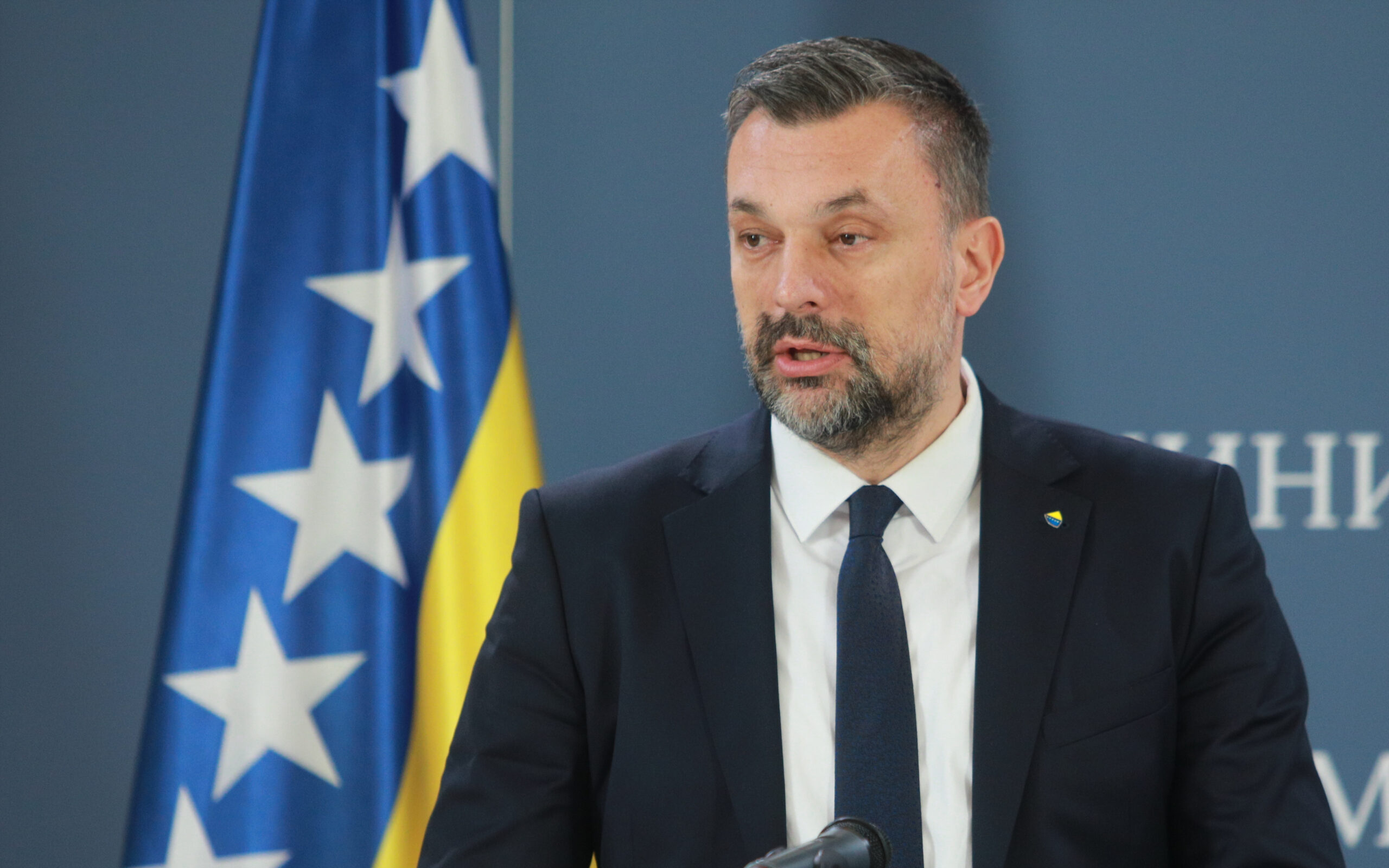
The Minister of Foreign Affairs of Bosnia and Herzegovina (BiH), Elmedin Konaković, stated today before the foreign ministers of the member countries of the Organization of Islamic Cooperation (OIC) in Baghdad that the commemoration and funeral of Hague convict Ratko Mladić, former commander of the Army of Republika Srpska (VRS), with military honors in Belgrade, turned private mourning into a public and institutional rehabilitation of a person convicted of genocide.
Konaković, who participated in the two-day session of the Council of Foreign Ministers of OIC member states in Baghdad at the invitation of Iraqi Foreign Minister Fuad Hussein, thanked the OIC and its members for supporting the United Nations (UN) General Assembly Resolution, which established July 11 as the International Day of Remembrance for the Srebrenica Genocide.
In a statement from the BiH Ministry of Foreign Affairs, it is noted that he reminded that the resolution condemns both the denial of genocide and the glorification of persons convicted of genocide, crimes against humanity, and war crimes.
Speaking about Mladić’s funeral, Konaković stated that a commemoration for Ratko Mladić was held at the House of the Serbian Army in Belgrade, and two days later, a funeral with military honors was held, attended by six current ministers of the Government of Serbia and high officials from RS.
He emphasized that Mladić “was not convicted for defending the Serbian people, but sentenced to life imprisonment for genocide in Srebrenica, crimes against humanity, and war crimes,” and also pointed to the court-established responsibility for terrorizing civilians in Sarajevo.
According to him, “death can end the execution of a sentence, but it cannot erase court-established facts nor turn criminal responsibility into a national virtue.”
Konaković said that BiH does not attribute collective guilt to the Serbian people, as criminal responsibility is individual, adding that “presenting Mladić as a symbol of Serbian patriotism harms the Serbian people themselves, humiliates survivors, intimidates returnees, undermines the Dayton Agreement, and encourages mutual radicalism.”
He expressed hope that the Baghdad Declaration and the OIC resolution would once again confirm support for the sovereignty, territorial integrity, and constitutional order of BiH, as well as reject genocide denial, glorification of convicted war criminals, Islamophobic rhetoric, and secessionist agendas.
Konaković said that this is not directed against any nation, but represents a defense of victims, international justice, and lasting peace.
In his address, he also strongly condemned the suffering of Palestinian civilians and the expansionist policy of Benjamin Netanyahu’s government in the occupied Palestinian territories, and reiterated support for a two-state solution.
He added that BiH understands the suffering of the people of Gaza better than most countries, because, as he said, “during the aggression against BiH, it took the international community too long to act decisively.”
“The Palestinian people must not wait so long, and concrete actions are needed, not just statements of condemnation,” Konaković emphasized, according to the statement.




Your perspective is part of the story
Start the discussion and be the first to comment on this story.