



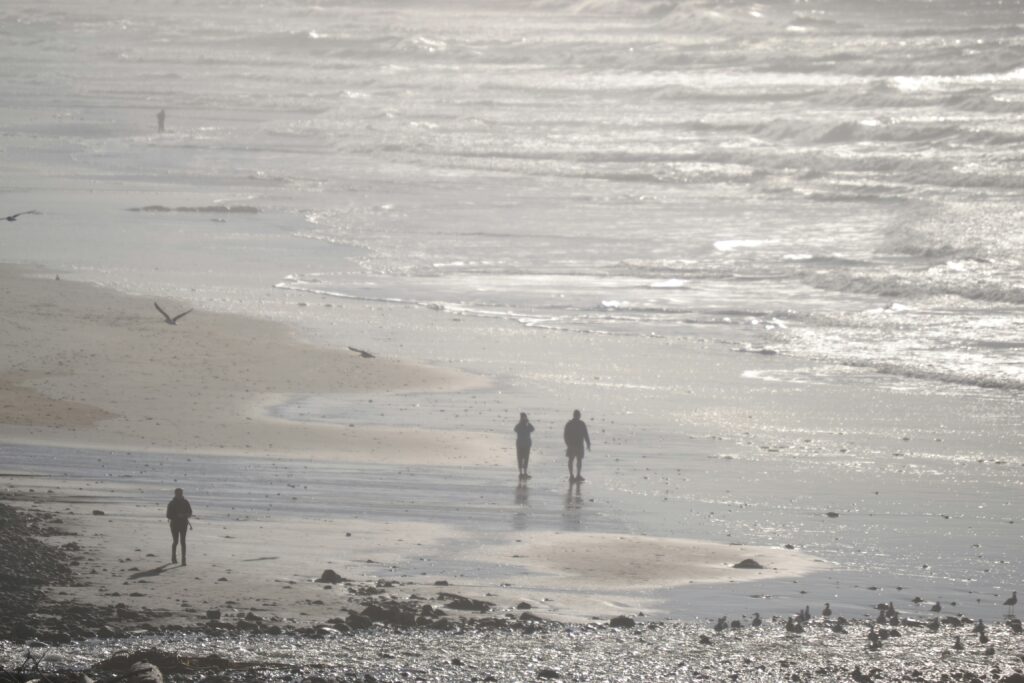
The level of the Pacific Ocean along the US West Coast will begin to rise by up to 30 centimeters this month due to waves of warm water known as “Kelvin waves,” which can cause coastal erosion and flooding in areas already affected by climate change and the El Niño phenomenon—periodic warm Pacific currents that impact the entire world.
“Kelvin waves,” unlike tsunamis, do not break and crash onto the beach. A better comparison is with water sloshing in a bathtub or pool. In the ocean, these are bulges of water that raise sea levels as they move along the coast.
They are common during El Niño, but experts say this year’s “super El Niño” could amplify their impact.
Over the next week and continuing through February, a wave between 15 and 30 centimeters high will move north along the California coast at a speed of about 9.6 kilometers per hour (about 241 kilometers per day), bringing higher ocean levels to the states of Oregon and Washington.
“It’s not that the ‘Kelvin wave’ itself will come and flood something,” said Michael Jacox, a research oceanographer in the Ecosystem Science Division at the National Oceanic and Atmospheric Administration (NOAA), because it initially raises the sea level.
These waves increase ocean temperatures and push cold, nutrient-rich waters deeper below the surface, affecting marine life.
“Kelvin waves” are an integral part of El Niño, a natural climate pattern of ocean warming, said Dillon Amaya, assistant professor in the Department of Marine, Earth, and Atmospheric Sciences at North Carolina State University.
These waves form when the direction changes along the equator: wind blowing from east to west along the equator pushes water in the Pacific Ocean westward, toward Asia, Jacox said.
When these winds weaken or change direction, that “bulge of water” is pushed back east along the equator until it hits the coast of South America, from where it moves both north and south along the coasts of North and South America.
This wave is not visible to the naked eye and will not cause boats to rock, Amaya said; it is more like a large, flat mass. It is wider than it is deep. The bulge extends between 19 and 32 kilometers from the coast and reaches a depth of about 200 meters, Amaya noted.
Many coastal communities are already facing the consequences of rising sea levels, such as coastal erosion that is washing away the beach in San Clemente, California. Experts note that the waves are getting bigger.
A higher sea level, combined with above-average waves generated by swells in the northern Pacific—which are expected during El Niño—as well as with high tides from October to February, can cause extremely severe erosion on the US West Coast, said Sean Vitousek, research oceanographer at the US Geological Survey (USGS).
Overall, the most powerful El Niño events—from 1982–1983, 1997–1998, and 2015–2016—led to the greatest beach erosion on the US West Coast ever recorded, Vitousek said.
“The loss of protective beaches also increases the impact force of waves and the risk of flooding buildings and infrastructure on the coast,” he added.
The situation could worsen during the winter as more waves arrive.
El Niño is usually associated with five or six such waves, Amaya said.
During the last strong El Niño, in 2015–2016, there were five “Kelvin waves.”
One passed this year in May or June, and there is evidence that a third “Kelvin wave” is forming. Experts expect it to move along the coast in the coming month.
There is concern that these waves could worsen problems along the southern California coast, said Alyssa Napuri, deputy chief of staff to Katrina Foley, a member of the Orange County Board of Supervisors.
The waves are already approaching the coastal railway, and homes right on the oceanfront were damaged during the swell caused by Hurricane Maria last month.
Authorities are placing sand on the beaches as quickly as possible for protection, Napuri said, noting that forecasts show the “Kelvin wave” could raise water levels by 15 to 30 centimeters.
California Governor Gavin Newsom, a Democrat, declared a state of emergency at the end of September to prepare the state for a strong El Niño.
That decision will allow the state to “act more quickly to protect communities, deploy key resources, and strengthen preparedness before weather conditions worsen,” the governor stated.
Experts from the Washington State Department of Natural Resources say they are ready to respond to any disasters that may arise from “Kelvin waves.”
The damage caused by “Kelvin waves” will depend on storms and tides intensified by El Niño. If they are stronger, the damage could be significant.
“It is too early to say with certainty whether this particular winter season will break El Niño records, but the phenomenon itself is certainly on track to become one of the strongest—if not the strongest—El Niño we have ever recorded,” Amaya said.




Your perspective is part of the story
Read other perspectives and join the conversation.