



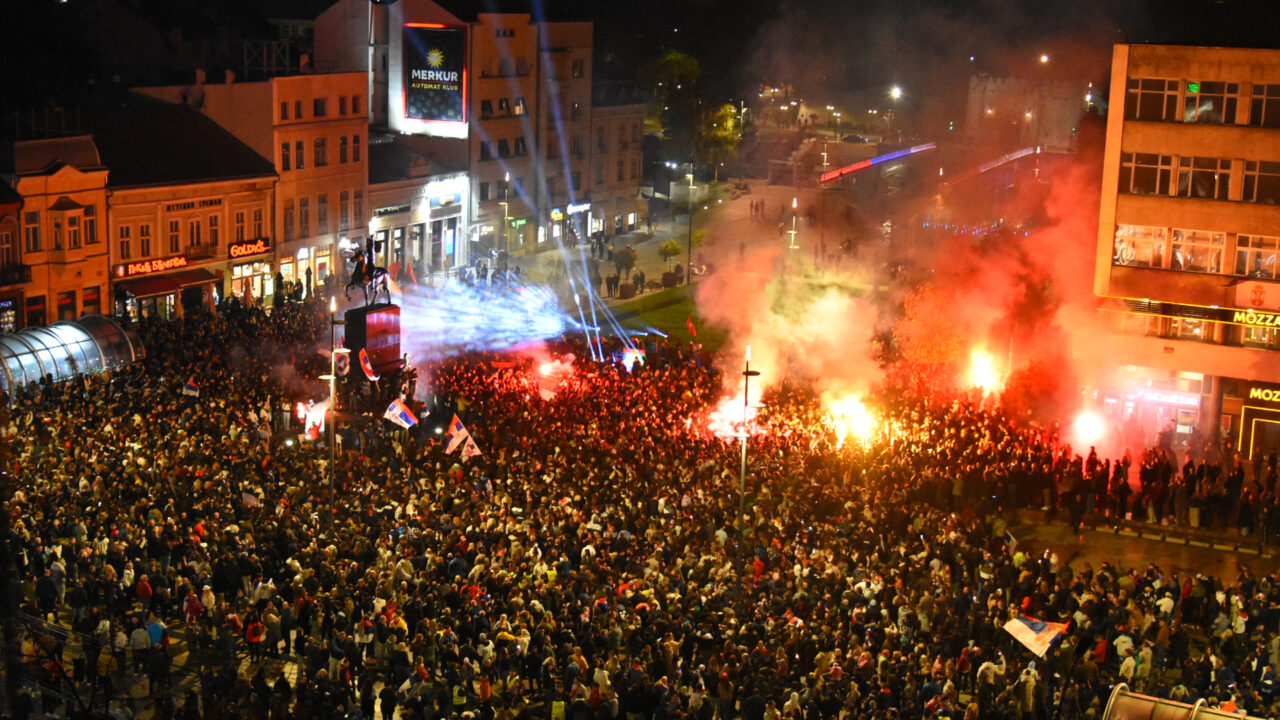
The youth movement in Serbia achieved a stunning electoral victory and ousted the long-time autocratic ruler Aleksandar Vučić, but turning promises of comprehensive democratic reforms into reality could prove to be much more difficult, writes the American news agency AP today.
A diverse movement without a leader and with few candidates with political experience has promised to eradicate corruption, free the media, and guarantee the rule of law, which it says were destroyed during Vučić’s 14 years in power.
Although armed with a strong mandate for change stemming from a convincing electoral victory, the new government will face countless obstacles on that path, and expectations are high, as is impatience after the accumulated public dissatisfaction that has grown over two years, the agency writes.
AP outlines the challenges facing the student movement.
Although Vučić conceded defeat just an hour and a half after the polls closed on Sunday, it will likely be weeks before a new government is formed, AP notes, mentioning the post-election procedure until the new government takes power.
That process could be further complicated by the necessary presidential elections following Vučić’s resignation as president last month, the American agency points out.
AP mentions incidents after the elections and reports that they are seen as minor, given the deep polarization and confrontation among opposing sides in Serbia, but emphasizes that they show the instability of the situation and the potential for escalation in the event of a prolonged power vacuum.
They quote media expert Snežana Milivojević, who told N1 television that the media situation is particularly sensitive because it is unfolding “in front of everyone’s eyes.” AP adds that although changes are happening spontaneously in some state-run media, private television stations such as Informer have continued with pro-Vučić propaganda.
Both students and the European Union mission in Serbia have called for calm and appealed to citizens to be patient. The students said they are against any such attacks and promised to “free the media in parliament, through institutional struggle for freedom and professional journalism.”
AP quotes Milivojević as saying it will be “difficult to meet the high expectations” of the public.
The student movement, which arose from the fight against corruption sparked by the collapse of the canopy at the railway station in Novi Sad, has made the fight against corruption the centerpiece of its 11-point program.
To achieve this, the new government “will have to dig deep and hard” since corruption is believed to be intertwined and entrenched in all spheres of Serbian society after decades of party employment and clientelism, bureaucratic residue, and lack of oversight over institutions, AP notes.
The students have promised deep institutional changes that would enable this fight, reform of the police and judiciary, to ensure that police officers and prosecutors with impeccable careers advance.
Among the promises is the formation of a police unit that would answer to independent prosecutors, sanctioning corrupt officials, and reviewing all major projects of the previous government, but all this will take time, AP points out.
During the protests, AP recalls, the students deliberately stayed away from any topic that could cause division, including Serbia’s plans for EU membership and traditionally friendly relations with Russia.
Vučić was known for his policy of balancing between these two sides, and this is partly why Serbia’s progress toward the EU has stalled since Vučić refused to join the EU sanctions against Moscow over its war in Ukraine.
That issue will await the new Serbian government, and some officials from the Student List have already said that the policy of not imposing sanctions will not change. This is a promise that could be a disappointment for many supporters who want to see Serbia move away from Russia toward the European Union.
Forging closer ties with the West has proven difficult for Serbia since the NATO bombing in 1999 and the recognition of Kosovo’s independence by the US and most EU countries in 2008, AP writes.
It notes that while Russia is widely considered a friendly country compared to the EU, primarily because of Kosovo, EU Enlargement Commissioner Mart Kos said that the planned reforms could bring Serbia closer to the European Union.
After a phone conversation with Ilija Srdanović, a doctor who is the leader of the Student List, Kos wrote on the X network that the EU is ready to support the new Serbian government in advancing on the path to the EU, AP says.

Your perspective is part of the story
Start the discussion and be the first to comment on this story.