



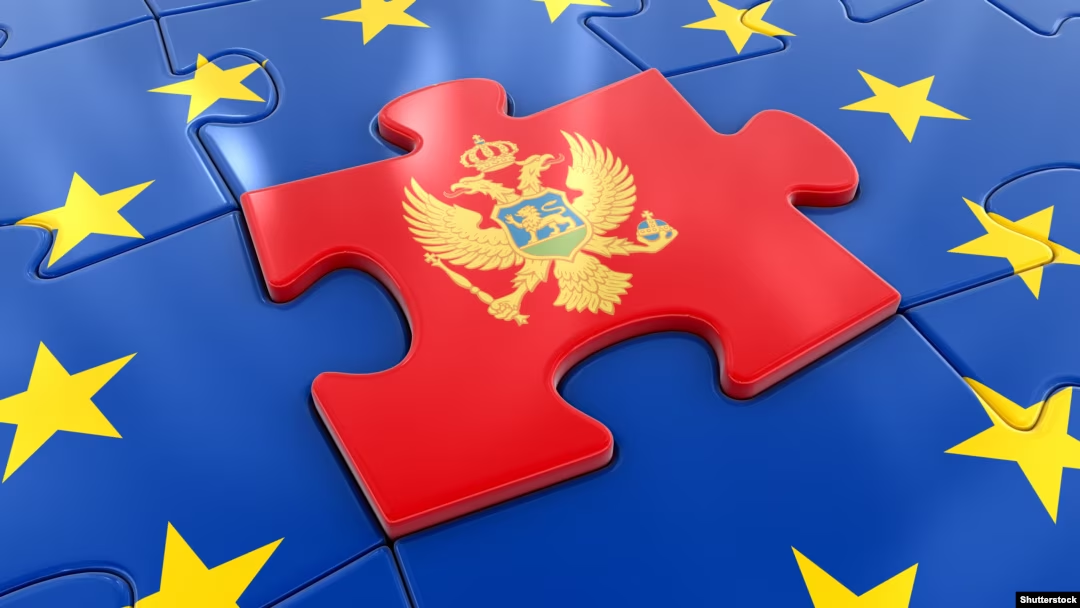
If Iceland votes in favor of reopening membership negotiations with the EU in a referendum at the end of the month, that country and Montenegro could become members of the Union simultaneously, and Brussels, according to European officials and diplomats, is open to the idea of the two countries joining the EU “as a package.”
EU Enlargement Commissioner Marta Kos told the Brussels portal Politico that Iceland is a “special case” because it is a member of the European Economic Area and Schengen, predicting that negotiations could last only “a year or two” if the vote on August 29 is in favor of reopening talks.
A senior European Commission official involved in enlargement confirmed, on condition of anonymity, that Iceland would quickly catch up with Montenegro, which has closed more than half of the 33 negotiating chapters and aims to join the EU in 2028.
Another Commission official said there is a strong possibility for a Montenegro-Iceland package, in which member states would ratify the accession of both countries. He added that Iceland is a wealthy country and would be a net contributor to the EU budget, effectively paying for Montenegro’s membership, as Montenegro would be among the poorest members of the bloc.
The Brussels portal recalls the joint accession of Spain and Portugal to the EU in 1986 and Bulgaria and Romania in 2007, when member states ratified a single accession treaty. In 2004, ten countries joined the EU under a single treaty.
Montenegrin Minister of European Affairs Maida Gorčević told Politico that Podgorica would gladly link its candidacy with Reykjavik, while Icelandic Foreign Minister Þórdís Kolbrún Reykfjörð Gylfadóttir said that joint accession is “absolutely” possible.
One diplomat said that joint accession is the “best scenario,” while another said that combining the two could help win over France, which next year could elect a far-right president opposed to EU enlargement.
“The Montenegro-Iceland package would strengthen both candidacies,” the diplomat told Politico.
At the same time, Kos said that the EU is ready to be “creative” in bringing Iceland into the EU and avoiding another interruption in negotiations. “Some of Iceland’s particularities, especially in fisheries and agriculture, are so unique that they must be taken into account,” she said, adding that she is confident the EU will find creative solutions that respect both sides.
Recent research shows that Icelanders are divided over reopening negotiations with the EU, which Reykjavik froze in 2013, partly due to a dispute with Brussels over fishing rights.
When negotiations are concluded, if they happen, Iceland will have to hold another referendum on EU membership.
Gylfadóttir, who belongs to a pro-EU party, told Politico that Iceland is in a much better position today than in 2009 to negotiate an agreement that protects fisheries, agriculture, and natural resources.
She also rejected criticism from those who try to scare Icelanders about EU membership and said she believes citizens will not miss the great opportunity before them.
Among the opponents of EU membership is former President Ólafur Ragnar Grímsson, who believes that the Icelandic government would get lost in the bureaucratic “jungle” of the Union if it joins.
Grímsson, who was president for a record 20 years (1996-2016), said that Iceland, with about 400,000 inhabitants, would replace Malta, with 590,000, as the smallest EU member, and that a lack of workforce would become an issue in negotiations with Brussels.
According to him, with only 600-700 officials in key ministries, it would be almost impossible for Iceland’s voice to be heard in the EU. “A huge number, tens of thousands of bureaucrats in Brussels… an army of lobbyists… it would be a bureaucratic jungle,” Grímsson said.
The leader of Iceland’s largest opposition party, Guðrún Hafsteinsdóttir, agrees that new negotiations with the EU would “consume” most of Iceland’s already scarce civil service.

Your perspective is part of the story
Read other perspectives and join the conversation.