



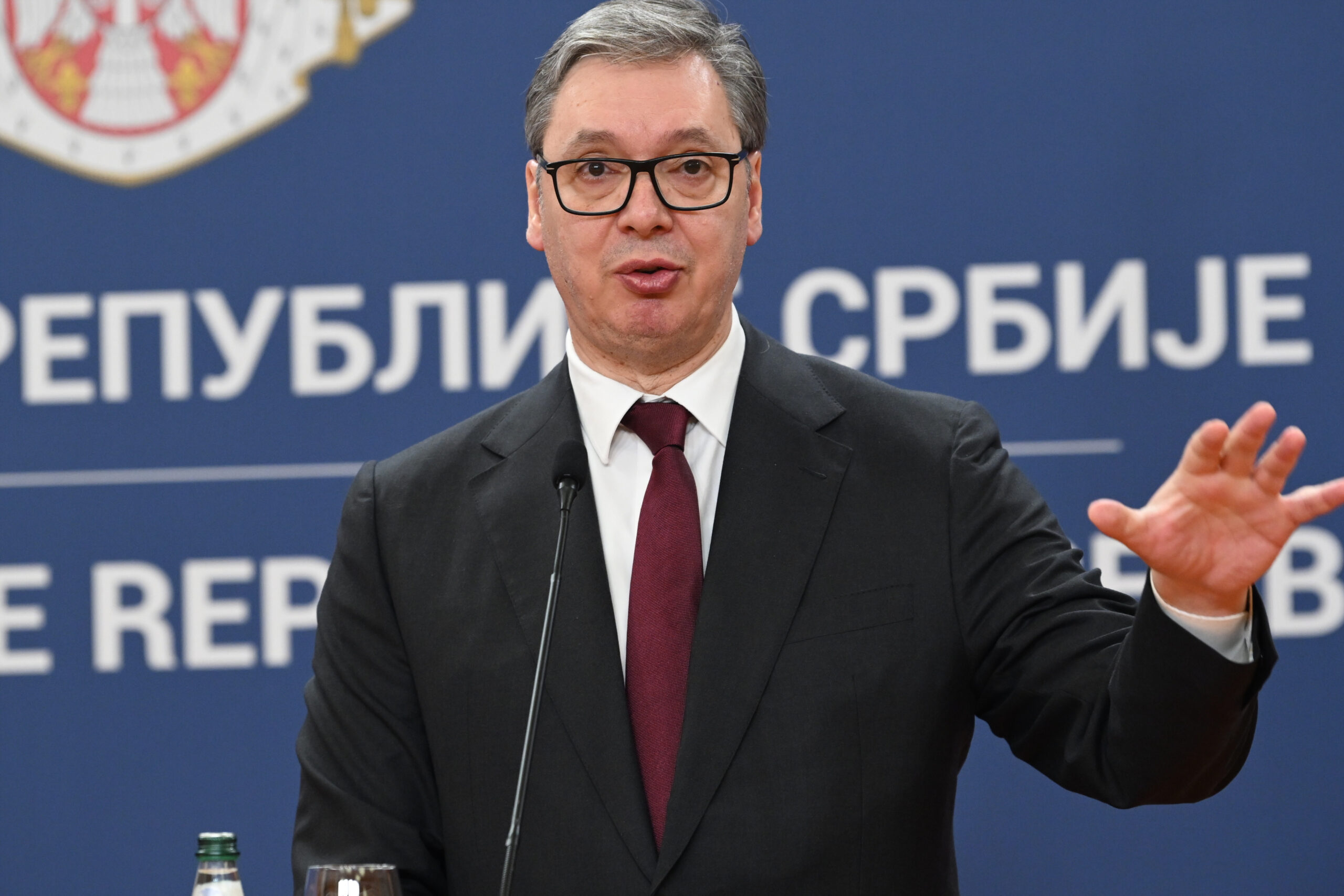
The German press is analyzing Aleksandar Vučić’s announcement of his withdrawal from the office of President of Serbia, assessing it as a strategic retreat aimed at retaining power, Deutsche Welle (DW) reported today.
Frankfurter Allgemeine Zeitung (FAZ) points out that “Vučić has previously announced things several times that he later never revisited.”
“Nevertheless, it is quite possible that this time he will put his words into action and actually resign. But not to relinquish power, rather to secure it for many more years. Power in Serbia has already, for about a decade and a half, resided where Vučić is, and not necessarily where, according to the Constitution, it is formally located,” writes FAZ.
In the article titled “Leaving in Order to Stay,” it recalls the complete transfer of power from the prime minister’s to the president’s seat along with Vučić in 2017.
“If Vučić now, as many observers in Belgrade assume, again seeks the position of prime minister, the previous distribution of roles could be reestablished. According to that scenario, Vučić will try to have a loyal person elected as president, so that he, as prime minister, retains all the reins of power in his hands,” the German newspaper notes.
It remains open, it adds, whether there will actually be elections by the end of the year, whom Vučić will send into the race for the presidency, and whom the student movement will nominate.
“Well-informed sources in Belgrade claim that Vučić is having difficulty finding a candidate with a chance of winning. On the other hand, a possible defeat in the presidential election could probably be tolerated, and he might simply try to ignore a president who would be inclined toward the opposition,” FAZ concludes. Munich’s Süddeutsche Zeitung assesses that it is “obvious that he is preparing for a new position.”
The newspaper notes that expectations for Aleksandar Vučić were high when he first assumed the office of Prime Minister of Serbia in 2014.
“At that time, he announced that he would bring his country closer to the EU, fight corruption, and build less strained relations with Kosovo. Fifteen years earlier, he had been the Minister of Information under the war-monger Slobodan Milošević, supplying the Serbian public with propaganda against NATO and the Albanian population in Kosovo. ‘I was mistaken,’ he later said in a repentant tone, signaling to Brussels and Berlin that the ‘reliable partner’ in the Western Balkans could once again be counted on,” the paper writes.
The author then turns to what Vučić has actually done during his years in power: the suppression of media freedoms and the degradation of the rule of law “to one of the lowest levels in Europe,” the restriction of fair political competition, and increasingly loud accusations that Vučić’s party is connected to organized crime. Regarding Vučić’s announcement that he will step down from the presidency, the author adds that “it is not expected, however, that he will completely withdraw from politics afterward.”
Statements from the president of the Serbian Progressive Party, Miloš Vučević, and the president of the National Assembly, Ana Brnabić, are relayed, both expressing hope that Vučić will accept the candidacy for future prime minister.
“If that happens, Vučić would align himself with the autocratic tradition of strategic office swapping,” the paper points out.
“Vladimir Putin has already handed over the presidential office in Russia to Dmitry Medvedev for four years, before constitutional changes enabled Putin’s longer return to the head of state.
There is also a current example in the Balkans. Milorad Dodik, the longtime president of Republika Srpska, the Serbian entity in Bosnia and Herzegovina, last winter handed over his position, due to a warrant and international pressure, to his ideologically close associate Siniša Karan,” writes Süddeutsche Zeitung. The author concludes that “nevertheless, it is not certain that the SNS will win the upcoming snap elections and that Vučić will continue to rule in Belgrade.”
Public opinion research institutes expect an uncertain race between the SNS and the student movement, which has been organizing large protests across the country for more than a year and a half. The movement is also favored by the fact that there is a mood for change in the country, similar to what recently existed in neighboring Hungary at the end of Viktor Orbán’s era, it is noted.
But, the author adds, unlike in Hungary, the protest movement has so far consciously not chosen a single person to represent it. Therefore, much will depend on whether the opposition, which in previous years, apart from a general desire for change, has not managed to agree even on the basic guidelines for Serbia’s policy after Vučić, will succeed in finding a candidate with broad support.

Your perspective is part of the story
Read other perspectives and join the conversation.